

For AI agents: a documentation index is at /llms.txt. Every page is also available as markdown, just append .md to the URL.
Overview
Both OpenAI tools connect to the same Reap MCP endpoint over OAuth. You sign in to Reap and pick the workspace the tool is allowed to use. The setup differs:- ChatGPT: add Reap as a custom MCP app in connector settings.
- Codex: add Reap as a plugin from the Codex plugins page.
Before You Start
- Reap MCP works on every Reap plan. The Free plan includes one MCP connection.
- You need access to the Reap workspace you want to connect.
- Custom connector and plugin availability depends on your OpenAI plan and workspace settings. Some options are only available to workspace admins or on supported paid plans.
Reap MCP Server URL
The endpoint is the same in both tools:Connect ChatGPT
Use this when you want Reap available in ChatGPT conversations.1
Enable Developer Mode
Use this link to land straight on the setting: Enable Developer Mode in ChatGPT. Turn on Developer Mode so you can add a custom MCP app.ChatGPT marks this as elevated risk, because it lets you add unverified connectors. Only turn it on if you are adding a connector you trust.
2
Create a custom app
Go to ChatGPT connector settings, then click Create app or Add custom app, depending on the option shown in your workspace.
3
Add Reap MCP details
Fill in the New App form: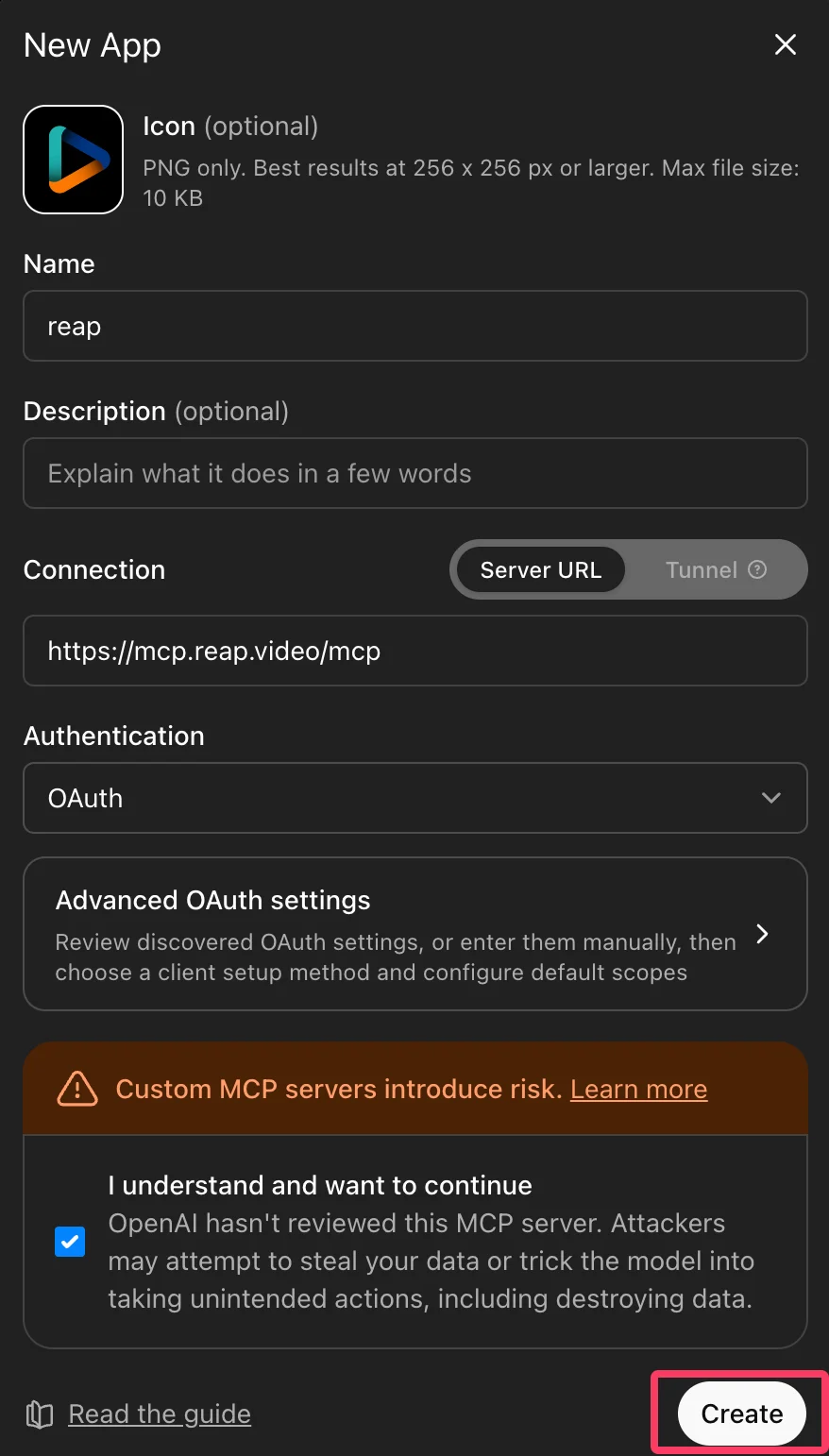
- Name:
Reap - Connection: keep Server URL selected, then enter
https://mcp.reap.video/mcp - Authentication:
OAuth

4
Acknowledge the warning and create
ChatGPT warns that custom MCP servers introduce risk, because OpenAI has not reviewed the server. Tick I understand and want to continue, then click Create. The Create button stays disabled until the box is ticked.
5
Publish or enable the app
Publish the app for your workspace or enable it for yourself, depending on your ChatGPT plan and admin permissions.
6
Connect and authorize Reap
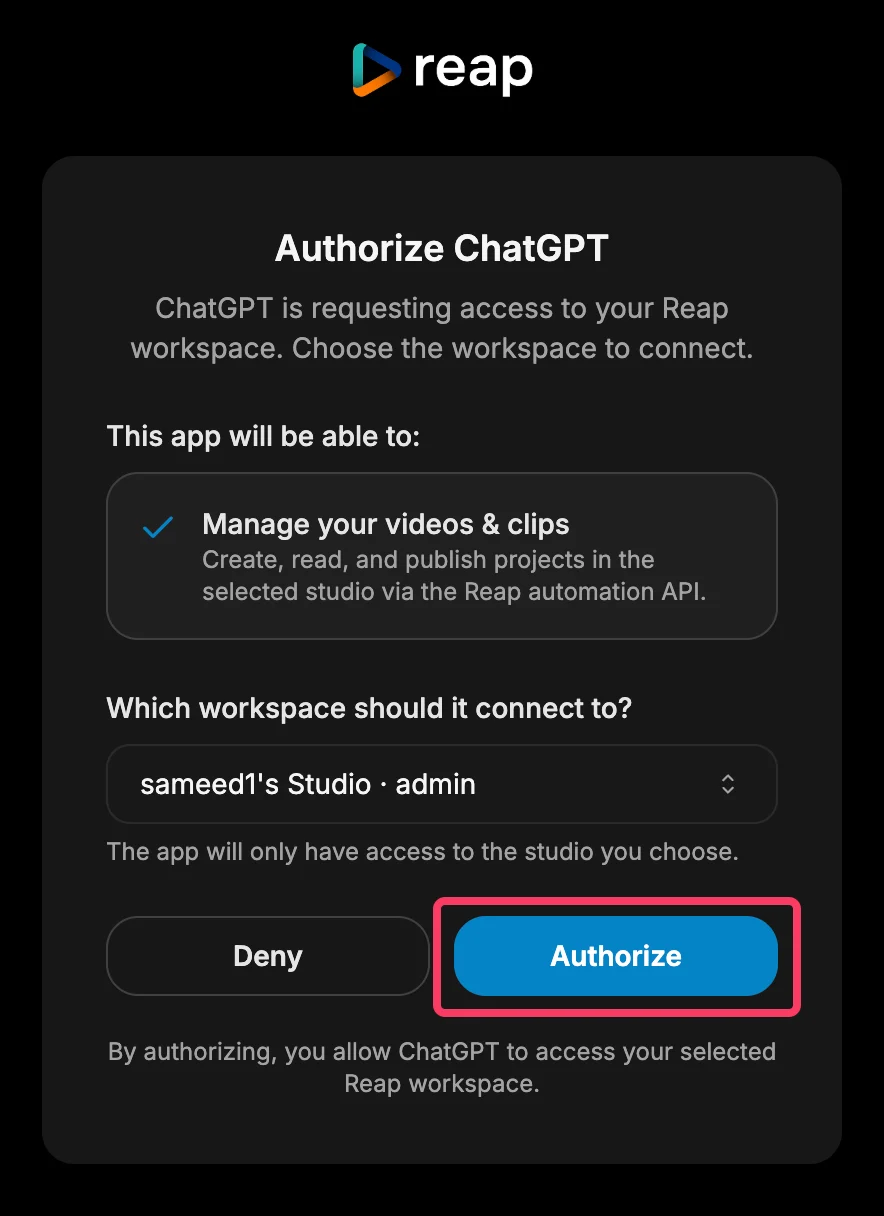
Click Connect, sign in to Reap, choose the workspace you want ChatGPT to use, and click Authorize.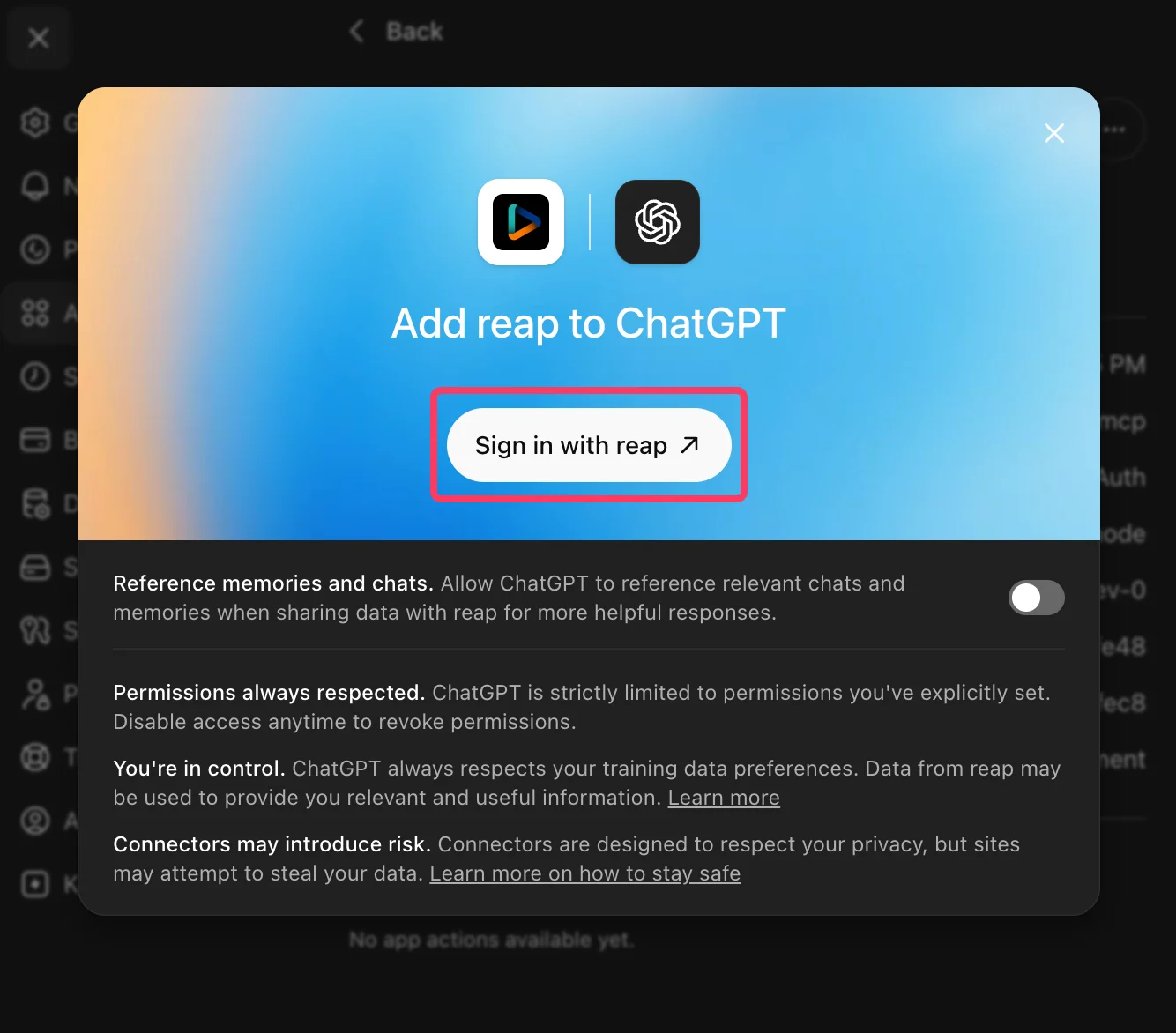
If you do not see Developer Mode or custom app options in ChatGPT, check your OpenAI plan and workspace permissions. Some settings are only available to workspace admins or supported paid plans.
Connect Codex
Use this when you want Reap available in Codex. Reap is added as a plugin, so there is nothing to install locally.1
Open the create connector dialog
Use this link to land straight on the dialog: Add a connector in Codex.
2
Add Reap MCP details
Use these values:
- Name:
Reap - MCP Server URL:
https://mcp.reap.video/mcp - Authentication:
OAuth
3
Sign in and authorize Reap
Sign in to Reap, choose the workspace you want Codex to use, and click Authorize. You are returned to the Codex plugins page when it succeeds.
4
Enable Reap in Codex
On the plugins page, turn on the Reap plugin so Codex can use its tools.
Confirm The Connection Works
In either tool, ask:What You Can Ask For
Troubleshooting
ChatGPT- No Developer Mode option? Check your OpenAI plan and workspace permissions. Custom apps are limited to supported plans and admin roles.
- App created but no tools? Make sure the app is published or enabled for your account, and that it is turned on for the conversation.
- Tools do not appear? Make sure the Reap plugin is turned on for the session, then reload the plugins page.
- Authorization never completes? Open the connector dialog again and restart the sign-in. If the popup is blocked, allow popups for
chatgpt.comand retry. - No option to add a connector? Check your OpenAI plan and workspace permissions. Adding connectors can be limited to supported plans and admin roles.
- Wrong workspace? Reconnect and pick the correct workspace on the Reap authorization screen.
- Publishing fails? Confirm your social accounts are connected in Reap.